Showing posts with label Science. Show all posts

Wednesday, October 17, 2012

Pandora Found!

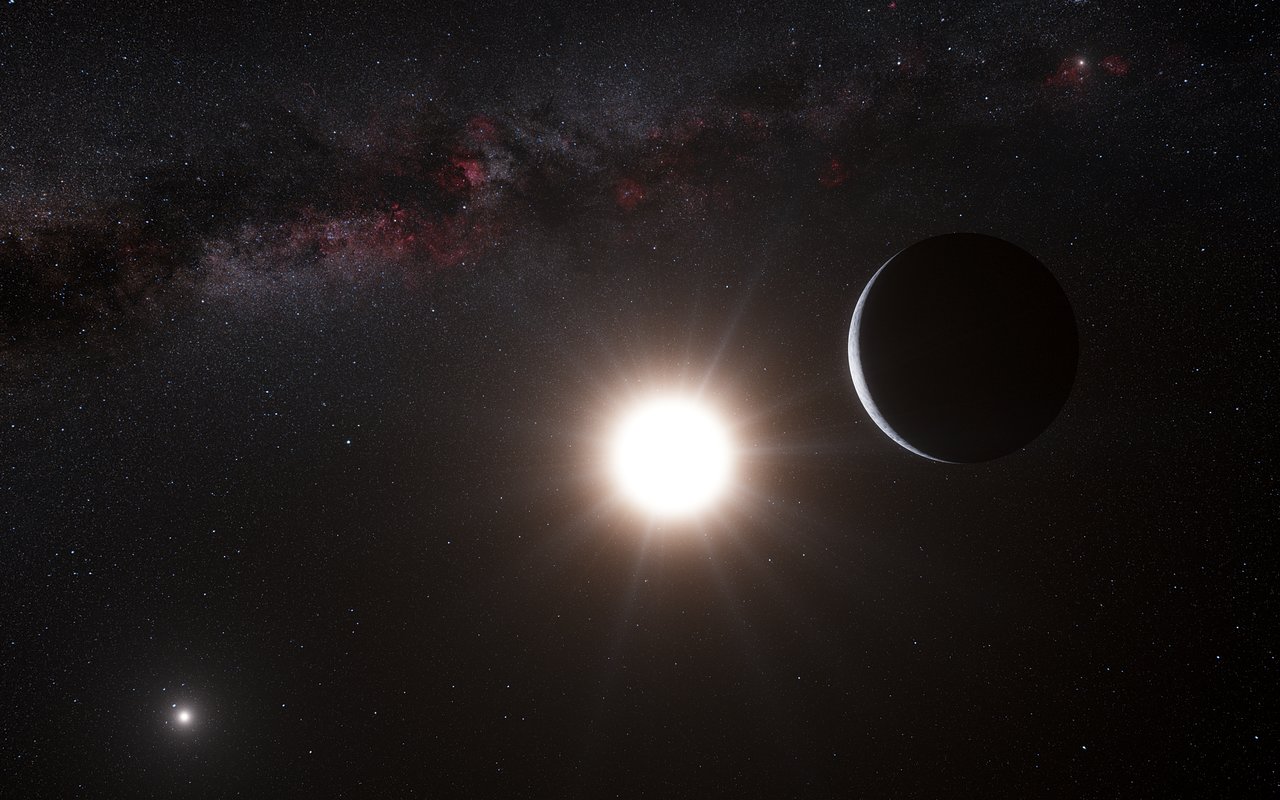
Okay, it's not eactly Pandora (Avatar, not Borderlands), but this is still awesome.  Yesterday astronomers at the European Southern Observatory announced they had found a planet slightly larger than Earth.  While that's cool by itself, the nerd in me squealed in delight because the planet is orbiting Alpha Centari B, which is a member of the star system closest to our own. 


An artist's impression of Alpha Centauri Bb from the ESO press release

Sure, the planet is only four million miles from its star, making it far too hot for life...but it's only 4.3 light years away from us!  That's tantalizingly close.  If a planet like that can exist in our backyard, who knows what else might be out there.  At this rate, it's only a matter of time until we start locating potential habital worlds.  Sure, our current technology can't get there in any reasonable length of time, but with a little investment, and the motivation that likely exploration targets could generate, you never know.  I'll admit, I yearn to live long enough to see the first close-up images of a planet outside our solar system with life, intelligent or not (most likely not).

Between Kepler's findings, the Curiosity rover's landing on Mars, and now this, it's been an exciting couple of years for astronomy.  I can't wait to see what we find next!

You can find the press release here and some great analysis from Phil Plait here.
Saturday, February 27, 2010

I Knew It!

Now I have science justifying my prejudices:

Political, religious and sexual behaviors may be reflections of intelligence, a new study finds.

Evolutionary psychologist Satoshi Kanazawa at the the London School of Economics and Political Science correlated data on these behaviors with IQ from a large national U.S. sample and found that, on average, people who identified as liberal and atheist had higher IQs. This applied also to sexual exclusivity in men, but not in women. The findings will be published in the March 2010 issue of Social Psychology Quarterly.

Hey, it’s science, and you know you can’t fight science! Since all of the above apply to me, I must be a genius. Score!

Seriously though, I wouldn’t read too much into a single study. There could be other factors at work or a mere coincidence. Still, it’s interesting to see someone noticed a correlation. I invite you to make your own conclusions.

On a side note, how long until Fox News throws a temper tantrum about this one?

Sunday, February 7, 2010

We Now Know (Some) Dinosaurs' Colors

I find this very cool because most assumed it would be impossible to know dinosaurs' actual colors. However, over the past two weeks, that has changed. Two separate teams of paleontologists, studying the incredibly well-preserved feathers of dinosaurs found in the Liaoning Province of China, have announced the first scientific determinations of dinosaur color.

The first study, published in the journal Nature, concerns the thin feathery filaments covering the turkey-sized Sinosauropteryx (pictured left). The research team was able to locate fossilized melanosomes, the same cellular structures that give modern birds their feather colorations. After studying these melanosomes, the paleontologists were able to determine that the Sinosauropteryx's feathers were a light brown in color.

Another study published this week in Science goes even further. Using more advanced techniques, the paleontological team behind the study analyzed the entire color scheme of the chicken-sized Anchiornis, and were able to create a full body rendering of the creature when it was alive (pictured below).


Just looking at the stark color differences between these two dinosaurs means there must have been incredible color diversity amongst all dinosaurs, just like modern birds. Sure, this technique won't help us with non-feathered dinosaurs such as Tyrannosaurus or Edmontosaurus, but these studies do show that we should never say never. Who knows what science may uncover.

Sinosauropteryx illustration courtesy of James Robbins. Anchiornis illustration courtesy of Michael DiGiorgio.

Tuesday, February 2, 2010

The End of Constellation

One of the big news items of the day is that President Obama's proposed budget for FY 2011 includes a cancellation of NASA's Constellation program. The program was meant to create a multipurpose vehicle that would replace the soon to be retired space shuttles. Additionally, Constellation was meant to carry astronauts back to the Moon and on to Mars by 2020. While disappointing, I think cancelling this program is for the best.

With the nation's fiscal woes, NASA's budget isn't going to grow much larger (although the 2011 budget does propose a slight increase). Cost overruns for Constellation would have cut into the rest of NASA's budget, thereby forcing the agency to sacrifice more and more worthy projects in the name of manned space flight. Don't get me wrong, I think it would be incredible to send people to Mars. But is it worth it? Look at just some of the incredible work being done by unmanned probes: Cassini has been sending us breathtaking images and measurements of Saturn and its moons. The Spirit and Opportunity rovers have been tottering about Mars for the past 6 years (Spirit recently became stuck, but it can still conduct scientific measurements from where it's at). Kepler might locate other Earth-like worlds around other stars. New Horizons will provide us with our first up-close images of Pluto. And that doesn't even touch on NASA's aeronautical and meteorological research. All told, these sorts of missions provide far more data and benefit than sending a handful of people to the Moon and Mars for brief periods of time.

Sure, the shuttles are nearing their retirement, so NASA won't be able to send humans into space by itself. However, without the huge money hole of the shuttle, NASA can shift funding towards unmanned exploration of more places, finding more efficient means of carrying humans to the stars, and understanding our own planet better. Once space travel becomes more cost effective, or we find something we truly must see first hand (alien life, perhaps), then it will be worth the cost of sending people. Until then, let's cast a wide net and examine as much as we can with our available resources.

Thursday, January 14, 2010

New Horizons

A couple weeks ago, NASA's New Horizons probe reached the halfway point between Earth and Pluto. On June 14, 2015, it will finally reach the planetoid, taking high resolution photos as it flies by. I don't know why, but I'm more excited about this probe than most (I'd say Kepler is the only current one that has me more intrigued). Maybe it's the fact that New Horizons is going to be the first ever flyby of Pluto, and we'll finally have an idea of what our distant neighbor actually looks like. There's nothing quite like looking upon a distant land for the first time.

From the New Horizons website, here's a cool pic showing the probe's current location:


Getting there!

Tuesday, January 12, 2010

Oh, the Possibilities

National Geographic has short article on their site about a recent study which determined roughly 15 percent of all stars in the Milky Way galaxy may be similar to ours, which increases their likelihood of harboring life.

From the article:

The research is based on surveys of stars with gas giant planets—similar to Jupiter and Saturn—that orbit far from their stars.

As in our solar system, vast distances stretch between these stars and their gas giants. This creates ample room for rocky planets to thrive in the stars' habitable zones, the regions where liquid water can exist.

And that boosts the likelihood that other Earths, and maybe even other forms of life, abound in the Milky Way.

Hopefully, the Kepler Space Telescope and future missions will be able to support this article's conclusions. Unfortunately, it will take a couple of years before we have any answers from Kepler (to see how Kepler works, I recommend Phil Plait's explanation). Being patient sucks!

Anyway, I love imagining the possibilities. There is just so much out there waiting to be explored. I only wish I would be able to see some of it in my lifetime. But who knows? Humanity might be able to send an unmanned probe to some of our nearest neighbors and send back pictures in time for me to see them. Only time will tell.

Sunday, January 10, 2010

Tetrapods Evolved Earlier Than Previously Thought...Cue the Creationists!

Paleontologists recently described a fossilized trackway discovered in Poland that dates to 395 million years ago.


Illustration and photograph by Grzegorz Niedzwiedzki, courtesy of National Geographic

What's cool about it is that paleontologists previously believed tetrapods evolved around 370 million years ago based on finds such as the Tiktaalik rosa which seemed to be a transitional form between fish and amphibians.  However, this new find reveals that tiktaalik was in fact an evolutionary holdover from a transition that occurred at least 20 million years earlier.  Unfortunately, we need more fossil evidence to properly pin down when the transition took place, but at least this find gives us a better idea of where to look in the rocks. Clearly, 395 million years old is too young!

Of course, the usual suspects are tripping over themselves to show that this invalidates tiktaalik's place as a transitional fossil and disproves evolution.  PZ Myers does a nice job explaining why that's simply not the case.  In short, evolution isn't a ladder, but a branching tree.  Creatures that were once transitional forms can continue to survive for millions of years as long as they can continue to reproduce (look at the coelacanth).  In this instance, tiktaalik is the descendant from a population of creatures that were the transition between fish and tetrapods.  Some of that ancestor population continued to survive in their transitional form, eventually becoming the tiktaalik, while others continued changing into tetrapods, including the ones that left their footprints behind in prehistoric Poland.  None of the scientists involved ever claimed tiktaalik was a definite ancestor of all tetrapods.  It was just a prime example of what the direct ancestor might have looked like.

It might be easier to explain using human evolution.  Imagine alien paleontologists are studying the Earth 350 million years in the future, and they have only a rough understanding of human evolution and few fossils to go on.  Then they find a fossilized chimpanzee skeleton followed a couple of years later by a more ancient set of Homo erectus footprints.  Would the alien paleontologists have to rule out evolution entirely because the more human-like footprints come before the apparent transitional form in the geologic record?  Of course not.  As we know, the chimpanzee is little changed from the transitional form between humans and all other primates.  However, we also know it is not our direct ancestor, just a good example of what the common ancestor between apes and us might have looked like.  On the other hand, Homo erectus obviously lived before modern chimpanzees, but was well on its way to becoming human while still living at the same time as the chimp's ancestors.

Applied to the recent discoveries of tetrapod evolution, the tiktaalik is like the chimpanzee.  It's an approximate representation of a common ancestor, which continued to coexist among the ever-changing tetrapods.  When those early amphibians walked across an ancient beach in Poland, somewhere in the shallow waters of the world were the ancestors of the tiktaalik.  They had changed little from the common ancestor to both and would remain virtually unchanged for several million more years.

Anyway, this showcases part of what I love about science.  It's always changing in response to new evidence, bringing us closer to an accurate understanding of the world around us.  Isn't reality awesome?

Thursday, January 7, 2010

The Known Universe

If you haven't seen the video below, you really should check it out:


Sure puts things into perspective, doesn't it? And to think, there are people who think all of that is devoid of life and meant solely for us. Man, reality is so much more awesome.

Thanks to the American Museum of Natural History for making that video.